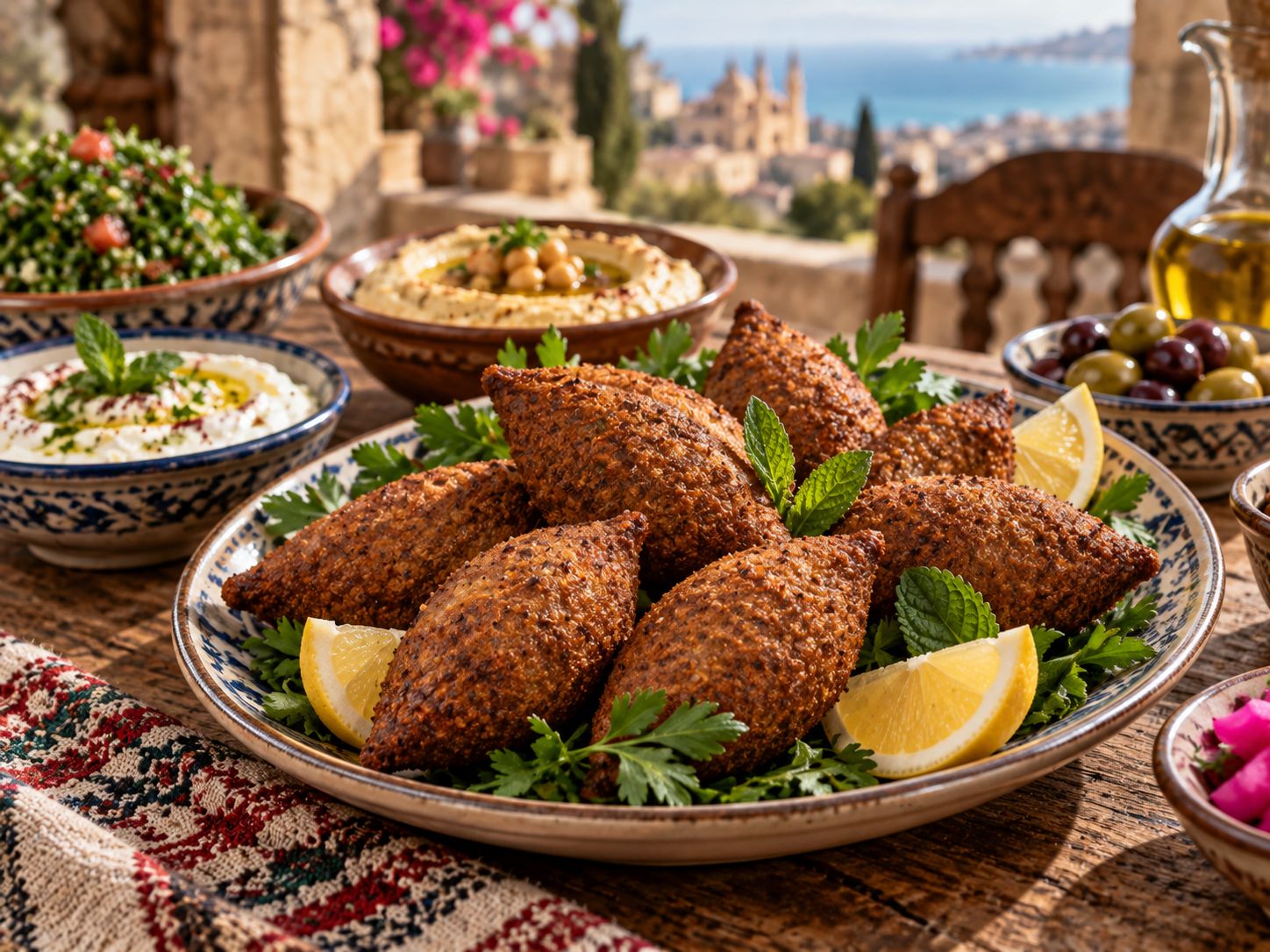
Lebanese Fried Kibbeh (Kibbeh Makliyeh)

Crisp Lebanese kibbeh croquettes made with a fine-bulgur and ground-beef shell, filled with spiced beef, onions, and toasted pine nuts. This recipe makes about 24 pieces, or 6 servings of 4 pieces each.
Foodemium

Lebanese Fried Kibbeh (Kibbeh Makliyeh)

Crisp Lebanese kibbeh croquettes made with a fine-bulgur and ground-beef shell, filled with spiced beef, onions, and toasted pine nuts. This recipe makes about 24 pieces, or 6 servings of 4 pieces each.
Prep Time 50 minutes
Cook Time 40 minutes
Chilling Time 30 minutes
Total Time 2 hours
Servings: 6 servings
Course: Appetizer, Main Course
Cuisine: Lebanese

Ingredients
  

BULGUR AND BEEF SHELL
  • 250 g Fine bulgur (No. 1) dry weight; use fine, not coarse bulgur
  • 500 g Lean ground beef very finely ground; keep cold, 90–95% lean
  • 1 medium Yellow onion about 150 g, grated or very finely chopped
  • 1 tsp Fine salt for the shell
  • 1/2 tsp Ground allspice for the shell
  • 1/2 tsp Ground cinnamon for the shell
  • 1/2 tsp Freshly ground black pepper for the shell
  • 3 tbsp Ice-cold water only as needed to bring the shell together
SPICED BEEF FILLING
  • 2 tbsp Olive oil 30 ml
  • 1 large Yellow onion about 200 g, finely diced
  • 350 g Ground beef approximately 10–15% fat
  • 40 g Pine nuts about 1/4 cup
  • 3/4 tsp Fine salt for the filling; adjust to taste
  • 1 tsp Ground allspice for the filling
  • 1/2 tsp Ground cinnamon for the filling
  • 1/4 tsp Freshly ground black pepper for the filling
FOR FRYING
  • 1.25 L Neutral frying oil such as sunflower or canola; actual amount depends on pot; most is not absorbed

Equipment

  • 1 Fine-mesh sieve For draining the bulgur
  • 1 Food processor For a smooth cohesive shell mixture
  • 1 Large skillet For the meat filling
  • 1 Mixing bowls For the shell and filling
  • 1 Heavy-bottomed deep pot For deep-frying; fill no more than one-third full with oil
  • 1 Instant-read food thermometer For checking oil temperature and cooked meat
  • 1 Slotted spoon and wire rack For draining fried kibbeh

Method
 

PREPARE THE BULGUR AND FILLING
  1. Rinse 250 g fine bulgur briefly, then cover with cool water by about 1 cm (1/2 inch). Soak for 15 minutes or until tender but not waterlogged. Drain very thoroughly in a fine sieve, pressing out excess water. Keep the drained bulgur ready for the shell.
  2. Heat a dry skillet over medium-low heat. Toast the pine nuts for 2–3 minutes, stirring continuously, until lightly golden; immediately transfer to a plate. They brown quickly.
  3. Heat 2 tbsp olive oil in the skillet over medium heat. Add the finely diced large onion and cook for 4–5 minutes until soft. Add 350 g ground beef, break it up, and cook for 7–9 minutes until browned, any released liquid has evaporated, and the meat reaches 71°C (160°F). Stir in 3/4 tsp salt, 1 tsp allspice, 1/2 tsp cinnamon, and 1/4 tsp black pepper. Fold in the toasted pine nuts.
  4. Spread the filling on a shallow plate and let it cool promptly. Refrigerate until cool before shaping; do not put hot filling into the raw meat shell.
MAKE AND SHAPE THE KIBBEH
  1. In a food processor, pulse the grated medium onion with the thoroughly drained bulgur until finely textured. Add 500 g cold lean ground beef, 1 tsp salt, 1/2 tsp allspice, 1/2 tsp cinnamon, and 1/2 tsp black pepper. Process in short pulses until a smooth, cohesive dough forms. Add ice-cold water, 1 tbsp at a time, only if needed; avoid making the dough wet. Work in two batches if your processor is small. Keep the raw mixture cold.
  2. Divide the shell dough into 24 roughly equal portions (approximately 40–50 g each, depending on moisture). Divide the cooled filling into 24 portions (about 24–26 g each). Keep unused shell mixture refrigerated while working.
  3. Moisten your hands lightly with cold water. Roll one shell portion into a ball; press your index finger into the center and rotate to form a thin-walled hollow, about 3–4 mm thick. Add one portion of filling without overpacking. Pinch the opening closed and shape into a pointed oval, roughly 8–9 cm long. Smooth over cracks with damp fingers. Repeat with the remaining portions.
  4. Arrange on a tray in a single layer and refrigerate for 30 minutes to firm up. Keep chilled until ready to fry; do not leave raw meat at room temperature while preparing batches.
DEEP-FRY AND SERVE
  1. Pour 1–1.5 L neutral oil into a heavy pot, ensuring the pot is no more than one-third full. Heat to 175°C (347°F) using an oil thermometer. Keep the oil between 170–180°C (338–356°F); never leave hot oil unattended.
  2. Lower 4–6 kibbeh at a time carefully into the oil without overcrowding. Fry for approximately 5–7 minutes, turning gently, until evenly deep golden and the raw-meat shell reaches 71°C (160°F) in the thickest part; verify with a clean instant-read thermometer. Let the oil return to temperature between batches. Cooking time depends on size and oil temperature.
  3. Lift the kibbeh out with a slotted spoon and drain on a wire rack. Serve hot, optionally with lemon wedges or plain yogurt served separately (not included in the ingredient list or nutrition). Makes about 24 kibbeh: 4 per serving.

Notes

Style: This is Lebanese fried kibbeh (kibbeh makliyeh / كبة مقلية), not baked kibbeh bil sanieh or raw kibbeh nayyeh. Regional and family recipes vary.
Bulgur: Use fine bulgur. Drain thoroughly after soaking: excess water can make shells crack or disintegrate in hot oil. If the dough remains loose, process it a little longer rather than adding extra water.
Yield: About 24 medium croquettes, 6 servings of 4. Piece count and weight depend on dough hydration and shaping. Chill the filling before stuffing and chill shaped kibbeh before frying.
Food safety: Keep raw meat refrigerated, prevent cross-contamination, and cook ground beef filling and shell to 71°C (160°F). Fry in a stable, heavy pot, do not overfill with oil, and use an oil thermometer.
Time: Prep 50 minutes, cooking approximately 40 minutes (filling and batches of frying), and chilling 30 minutes, for an estimated total of 2 hours. The 15-minute bulgur soak may overlap with preparing the filling; actual time depends on skill and batch size.
Nutrition: Values are intentionally blank because oil absorption, final edible yield, and specific beef fat percentages have not been measured or validated. Frying oil volume is not the amount consumed.

Tried this recipe?

Let us know how it was!

Leave a Reply

Your email address will not be published. Required fields are marked *

Recipe Rating